Lying for Money by Dan Davies
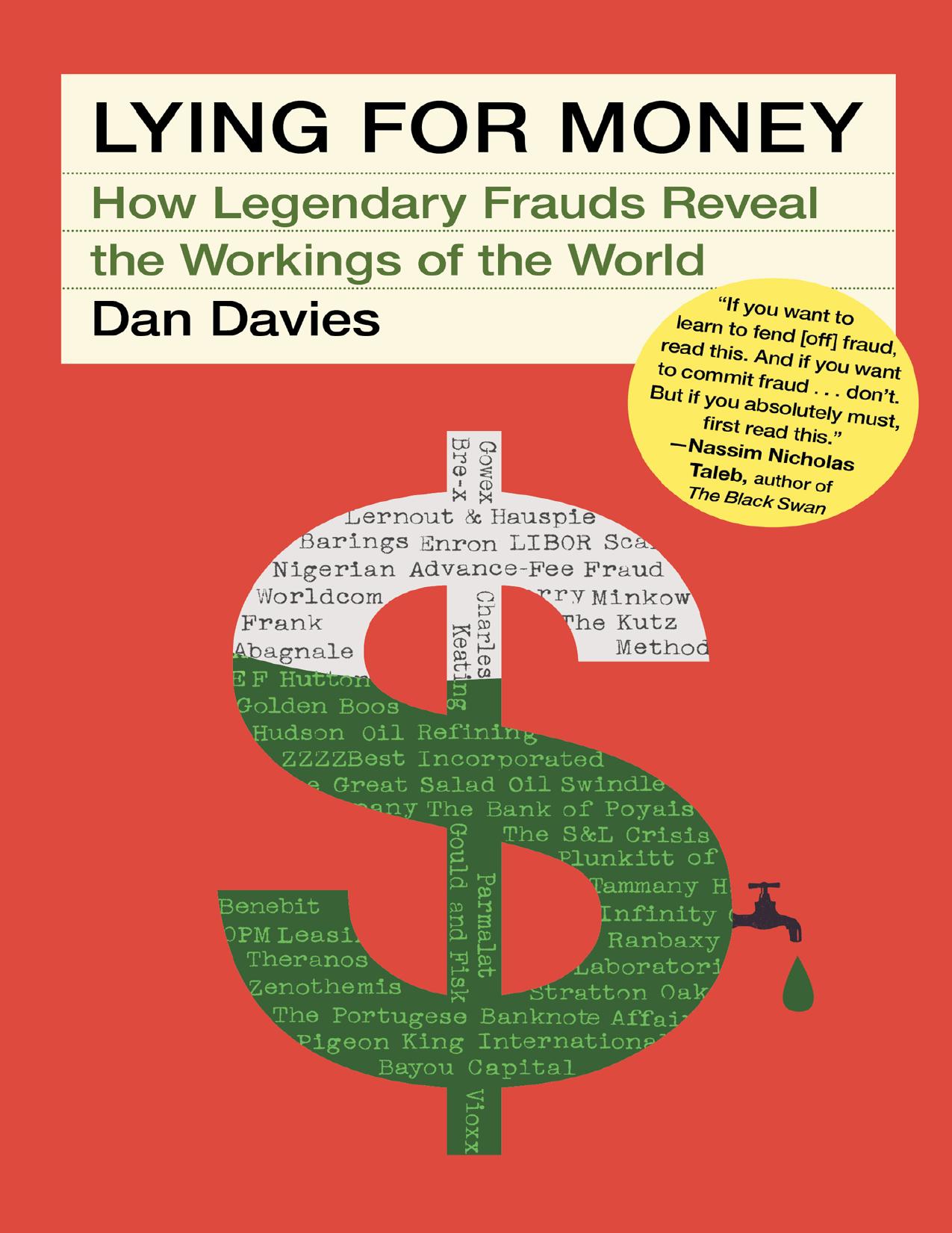
Author:Dan Davies
Language: eng
Format: epub, pdf
Publisher: Profile
Published: 2018-05-20T16:00:00+00:00
The Savings and Loan scandals
The Savings and Loan (S&L) crisis of the 1980s set the tone for many of the financial scandals to come. It was the first really major banking crisis of the post-Bretton Woods era and marked the transition from the inflationary 1970s to the hard-money era in the USA and into the Great Moderation. It also gave the first foreshadowings of the fact that financial deregulation tends to lead to crises; the interaction between the economic conditions of the time and the two major deregulation bills was particularly destructive. And related to this, the S&L crisis happened at the start of the Reagan era, as the power of government was being rolled back and that of corporations was waxing fat, leading to a sea change in the nature of the relationship between powerful bankers and the officials meant to supervise them. But most of all, for our purposes, it was with respect to the S&L industry that the term ‘control fraud’ really came of age.
It is probably fair to note at this point that the economic history of the S&L crisis is contested territory from an intellectual point of view, with both market-oriented and pro-government economists having written studies of the crisis which blamed the other side. Broadly speaking, if you did your economics degree in Chicago and call yourself a libertarian or small-government conservative, you tend to view the S&L crisis as the result of broad macroeconomic factors which destroyed the underlying business model of the industry and couldn’t be stopped. If you did your economics degree at Yale and vote Democrat, you tend to view it as the natural consequence of the deregulation of the sector removing constraints on the banks while keeping their implicit state guarantee, creating an inevitable incentive toward wrongdoing. Either point of view is defensible, because the S&L crisis was, in reality, at least two crises, and the policy measures which, partly successfully, aimed to solve the first arguably helped to bring about the second.
The crisis had its roots in the 1970s and the attempt to tame inflation by raising interest rates. Savings and Loans (also known as ‘thrifts’) were a kind of small bank which had grown up in the pioneer era, taking deposits and making loans in a small local area. The legacy of bank runs and instability in the early days of the USA had, before the 1980s, left a legacy of mistrust of large or multi-branch operations, but the S&Ls had strict limits on what they could do and tended to operate in uncompetitive local markets. For this reason, it was felt that they didn’t need much scrutiny from bank examiners. The joke about their style of banking was always that they followed the 3-6-3 rule: pay 3 per cent on deposits, charge 6 per cent for loans and make sure you are on the golf course by 3 p.m.
This was all very well. But it was a business model with an obvious failure mode. The loans
Download
This site does not store any files on its server. We only index and link to content provided by other sites. Please contact the content providers to delete copyright contents if any and email us, we'll remove relevant links or contents immediately.
Mindhunter: Inside the FBI's Elite Serial Crime Unit by John E. Douglas & Mark Olshaker(9271)
Wiseguy by Nicholas Pileggi(5722)
Room 212 by Kate Stewart(5078)
Hitman by Howie Carr(5045)
Secrecy World by Jake Bernstein(4710)
Killers of the Flower Moon: The Osage Murders and the Birth of the FBI by David Grann(4414)
Papillon (English) by Henri Charrière(4231)
Breaking Free by Rachel Jeffs(4198)
Killers of the Flower Moon by David Grann(4007)
Say Nothing by Patrick Radden Keefe(3949)
American Kingpin by Nick Bilton(3828)
The Secret Barrister by The Secret Barrister(3675)
Molly's Game: From Hollywood's Elite to Wall Street's Billionaire Boys Club, My High-Stakes Adventure in the World of Underground Poker by Molly Bloom(3515)
Mysteries by Colin Wilson(3429)
In Cold Blood by Truman Capote(3354)
Signature in the Cell: DNA and the Evidence for Intelligent Design by Stephen C. Meyer(3109)
I'll Be Gone in the Dark by Michelle McNamara(3058)
Rogue Trader by Leeson Nick(3020)
Bunk by Kevin Young(2976)
